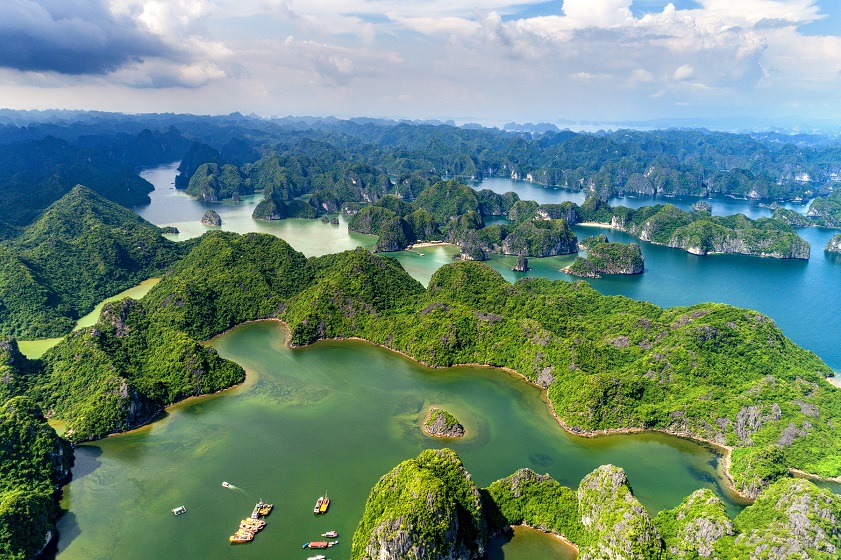
Lan Ha Bay doesn’t announce itself. It doesn’t need to.
There are no billboards. No influencer stampedes. No cruise ships lined up like floating hotels on a highway. There is just the water — jade-green and impossibly still — the limestone karsts rising in silence, and the particular quality of light that falls over northern Vietnam at dawn, turning everything gold and untouchable for exactly twelve minutes before the world wakes up.
We have spent years building journeys across this country. We have watched travelers return from Ha Long Bay with beautiful photographs and a vague feeling that something was missing — that the famous seascape they’d dreamed of was there, technically, but surrounded by so much noise that they couldn’t quite reach it.
Then we take those same travelers to Lan Ha Bay. And something different happens.
They go quiet.
article content
What Is Lan Ha Bay — And Why Have You Never Heard of It?

Lan Ha Bay stretches across roughly 7,000 hectares at the southeastern edge of Cat Ba Island — the largest landmass in the Cat Ba Archipelago, which juts dramatically into the Gulf of Tonkin in northern Vietnam. Within that stretch of water sit nearly 400 limestone islands, most of them unnamed on any tourist map, most of them untouched by anything resembling commercial development.
Geologically, Lan Ha Bay and Ha Long Bay are siblings — both products of the same extraordinary process: 500 million years of tectonic shifts, rising and falling seas, and rainfall carving through karst limestone to create the sheer, cathedral-like formations that rise from the water today. The difference isn’t geological. It’s administrative.
Ha Long Bay sits in Quang Ninh province, which has marketed and developed its waters aggressively for decades. Lan Ha Bay sits in Hai Phong province and has been allowed — through a combination of policy, conservation, and fortunate geography — to remain something increasingly rare in Southeast Asian tourism: genuinely, unapologetically itself.
In 2004, UNESCO recognized the broader Cat Ba Archipelago as a World Biosphere Reserve — a designation that reflects the extraordinary biodiversity here and a commitment, still very much alive, to keep it that way.
7 Breathtaking Experiences Only Lan Ha Bay Can Give You
1. Kayaking Into Places That Feel Like Secrets
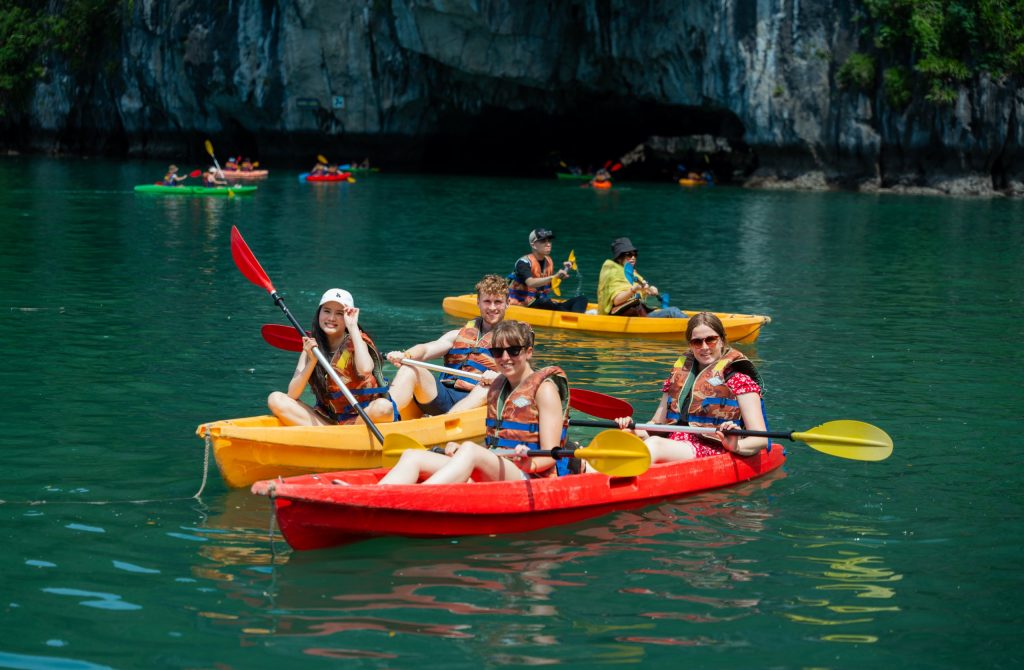
The karst formations of Lan Ha Bay are riddled with semi-enclosed lagoons the locals call hồ — lakes hidden inside limestone rings, accessible only through narrow cave passages at the right tide. You paddle in silence through darkness, your headlamp catching the cave ceiling close overhead, and then the passage opens and you emerge into a lagoon so perfectly still and so completely surrounded by rock that it feels impossible — like a place that shouldn’t exist.
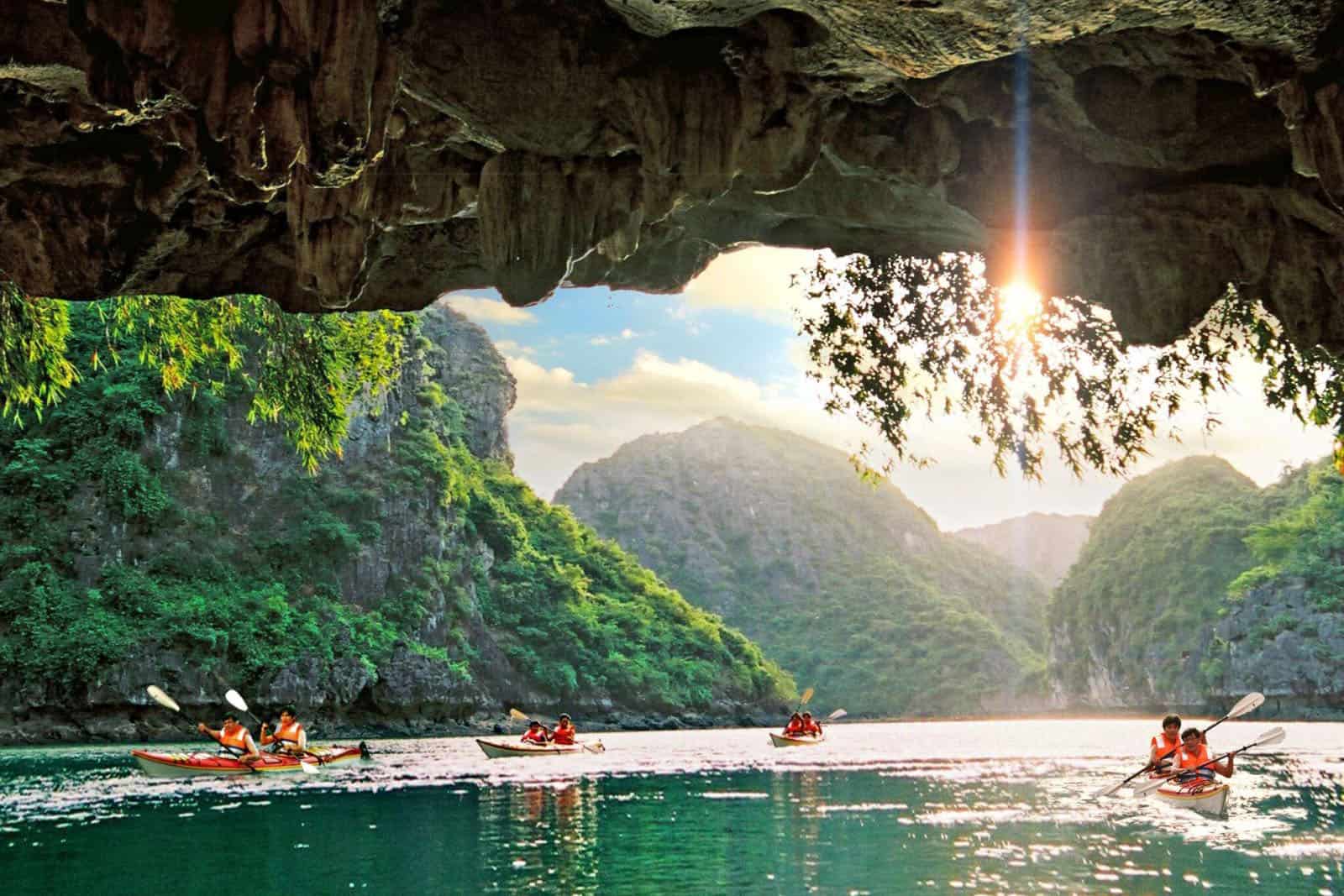 The Dark and Bright Cave route (Hang Tối & Hang Sáng) is, in our considered opinion as people who have done this dozens of times, one of the ten most extraordinary experiences available to a traveler anywhere in Southeast Asia. Not because it is dramatic. Because it is the opposite of dramatic. It is quiet and overwhelming in equal measure.
2. Beaches That Belong to You

Ba Trai Dao — Three Peach Beach — is three connected crescents of white sand cradled between karst islands, accessible only by kayak or small boat. On a weekday morning in shoulder season, you may be the only people on it.
Let that settle for a moment. A beach this beautiful, and it belongs entirely to you.
Bring nothing. Do nothing. Watch the light shift across the limestone. Let the silence settle into your chest. This is what travel is supposed to feel like, and it is increasingly hard to find.
3. Diving and Snorkeling in Living Water

The outer islands of Lan Ha Bay shelter coral ecosystems of remarkable health — a direct result of lower boat traffic and consistent conservation enforcement. Reef fish, sea turtles, cuttlefish, and (seasonally) squid are visible in water clear enough that snorkeling from the surface feels like watching a nature documentary from the inside.
Our DMC partners with PADI-certified dive centers on Cat Ba Island for half-day and full-day excursions across all experience levels. First-time snorkeler or advanced open-water diver — the bay rewards both equally.
4. Rock Climbing Above the Sea
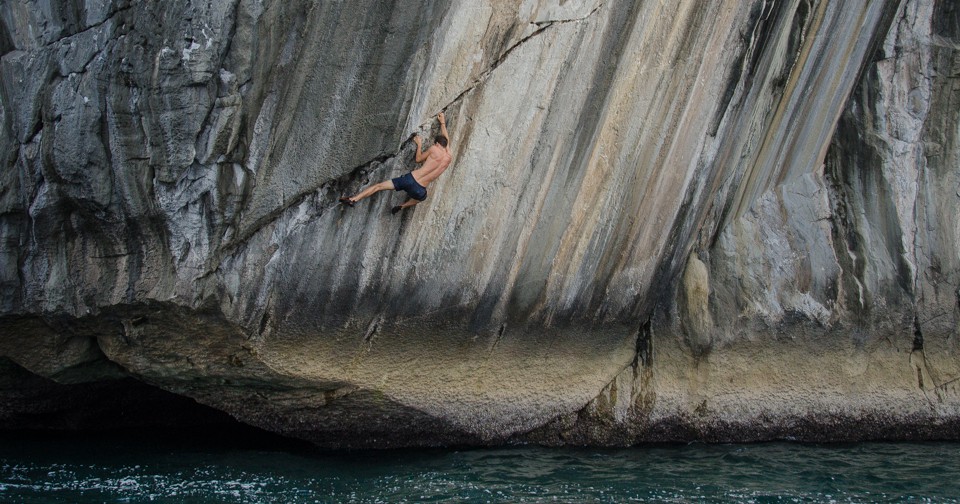
Cat Ba Island has become one of Asia’s most respected sport climbing destinations, drawing climbers from across Vietnam, Europe, and Australia to routes rated from absolute beginner to elite 8a+. The sensation of pulling yourself up a limestone wall above a bay this beautiful — with the karsts stretching to the horizon below you — is not something any photograph has yet managed to capture honestly.
Half-day introductory sessions with certified guides are available for first-timers. We include this in itineraries far more often than guests expect to want it. They always thank us afterward.
5. A Floating World Still Living on Its Own Terms
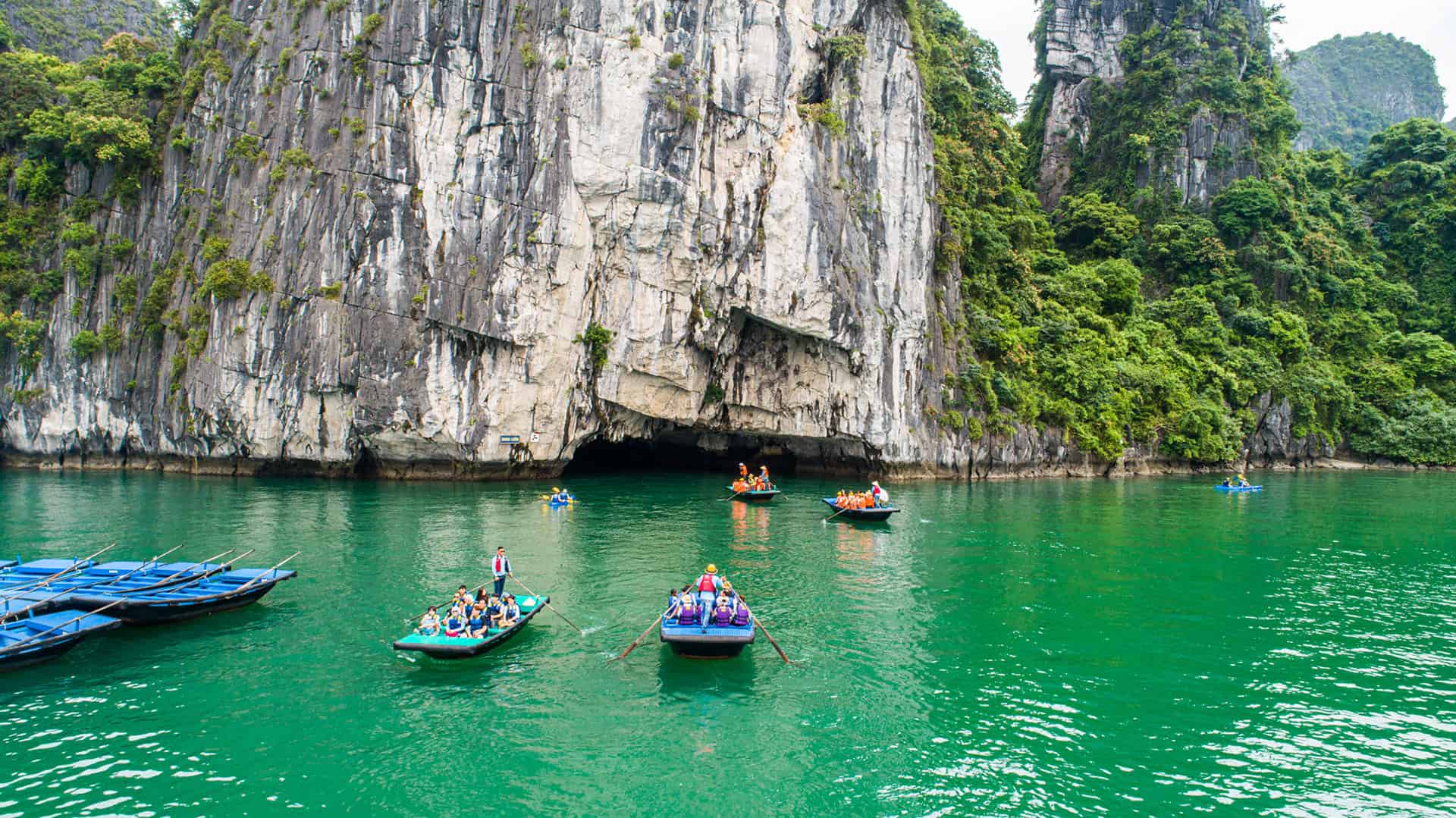
The fishing communities of Lan Ha Bay — unlike the more heavily touristed villages of Ha Long — are still working communities first and tourist attractions second. A guided boat tour through the aquaculture farms, where grouper, crab, and oysters grow in net cages rocking gently below the karsts, connects you to a way of life that has continued here for generations and still, stubbornly, persists.
These are not museum villages. They are people’s homes and livelihoods. Engage with that respect, and the experience is one of the most humanizing things travel can offer.
6. Hiking Cat Ba National Park to the Ridgeline

The interior of Cat Ba Island — designated a national park since 1986 — is a world entirely separate from the bay below it. Dense tropical forest, dramatic ridgeline trails, and viewpoints that reveal the full geometry of Lan Ha Bay spread beneath you: the islands, the water, the curve of the horizon, the sheer implausible scale of it all. The 4-hour Kim Giao Peak trail is the most rewarding, and the view from the summit at golden hour will rearrange something inside you.
7. Doing Absolutely Nothing, Extraordinarily Well
The final reason to visit Lan Ha Bay is also the hardest to sell and the easiest to understand once you are there.
You anchor in a quiet cove. The water is the color of celadon pottery. The light is doing something you have no name for. You have nowhere to be and nothing to prove.
This is not lazy travel. This is the highest form of it — the complete, deliberate practice of being exactly where you are. Lan Ha Bay is one of the last places left in Southeast Asia that makes this feel effortless.
The Sustainability Question — Why It Actually Matters Here
We are going to say something that marketing materials rarely say: not every destination should be visited by everyone.
Lan Ha Bay’s extraordinary preservation is not luck. It is the outcome of deliberate conservation policy, the work of the Cat Ba Biosphere Reserve, and a growing coalition of local operators who understand that the thing that makes this bay valuable — its wildness, its silence, its ecological health — is also the thing most easily destroyed by unchecked tourism.
When you book through a responsible DMC, you are not just purchasing convenience. You are participating in a model of tourism that has a genuine chance of keeping this place beautiful for the next generation of travelers.
We work exclusively with small-group cruise operators (20 guests maximum), locally owned guesthouses and eco-lodges, and guides who live on these islands and have a personal stake in their future. We keep groups small. We brief every guest on reef etiquette, kayaking protocols, and waste management before every excursion. We pay guides fairly and tip-share transparently.
This is not altruism. This is how good tourism works — and Lan Ha Bay is one of the clearest proofs we have that it can work.
When to Go & How to Get There
Best months: April–June deliver stable weather, calm water, 24–32°C temperatures, and exceptional visibility for diving. December–February brings mist and cool air that many photographers actually prefer — the bay becomes atmospheric and slightly otherworldly in a way the summer crowds never get to see.
Typhoon season (July–September) requires flexibility — always book with operators who offer real cancellation policies, not the kind printed in small text that means nothing in practice.
Getting to Lan Ha Bay:
From Hanoi, the Cat Ba Express — a combined bus and high-speed ferry — runs directly from the Old Quarter to Cat Ba Island in approximately 3.5 hours. From Hai Phong, the ferry from Got Pier takes 45 minutes. Both options can be arranged entirely by our DMC team, coordinated with your wider Vietnam itinerary so that not a single transfer is left to chance.
📩 Ready to make Lan Ha Bay your next great story?