
Hoi An and Ba Na Hills represent the perfect balance of tradition and wonder in Central Vietnam. From emerald waterways to a kingdom above the clouds, a trip to Hoi An and Ba Na Hills offers a diverse landscape that every traveler should experience. If you have already explored the North with a Hanoi City Tour, this Central route is the perfect next step.
Cam Thanh — A Secret the River Has Kept for Centuries
article content
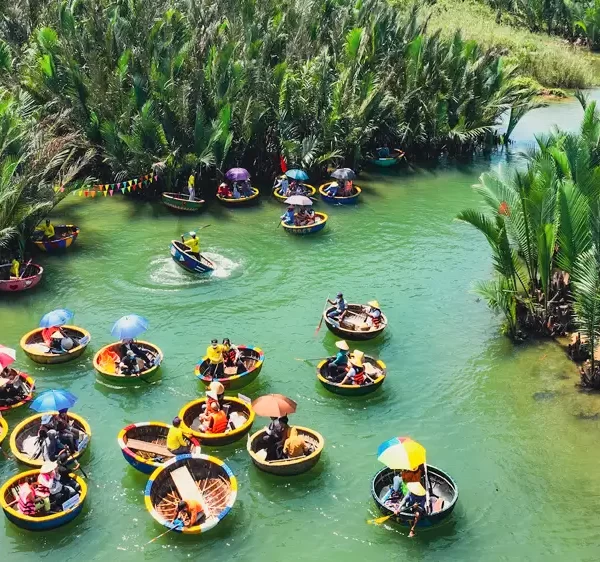
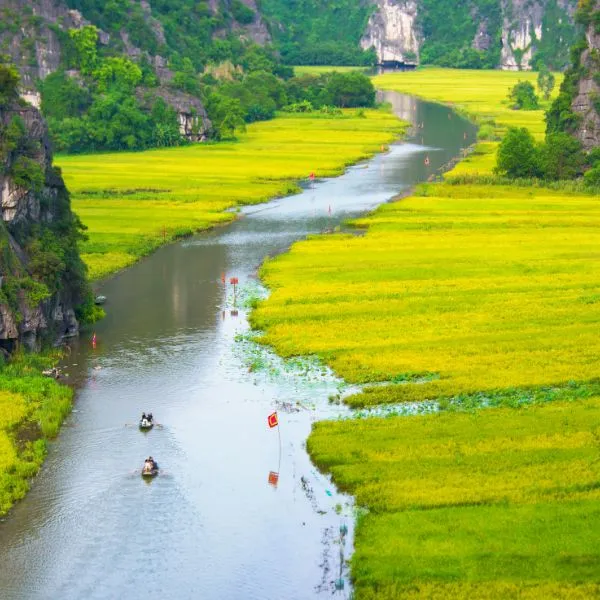
Tucked away in the quiet embrace of Hoi An’s outskirts, Cam Thanh Coconut Village feels less like a destination and more like a secret the river has been keeping for centuries. Seven hectares of nipa palm forest arch overhead in a seamless canopy of jade and emerald, filtering the afternoon light into trembling gold threads that fall across still, dark waters below. Sound here is a different language: the hollow knock of bamboo, the sudden splash of a fish turning in the shallows, the low creak of a basket boat rounding a bend. Time, as you know it, stops existing.
Climb into a round bamboo basket boat — the “thuyền thúng”, beloved icon of these waterways — and surrender yourself to the skill of a local oarsman who has known these channels since childhood. When traveling between Hoi An and Ba Na Hills, this stop provides the perfect cultural balance to the high-altitude wonders of the mountains. With a few flicks of the paddle, the boat spins and glides as if the water itself is dancing beneath you. Further in, the forest deepens and the sky narrows to a single sliver of blue between the palms. Here, you may cast a net alongside weathered fishermen, pull crab traps from the muddy riverbed, or take a cooking class where bánh xèo sizzles on a clay stove beside an open flame. Cam Thanh does not need to perform authenticity — it simply lives it, wholeheartedly, every single day.
Hoi An — Where Every Lantern Carries a Thousand Years
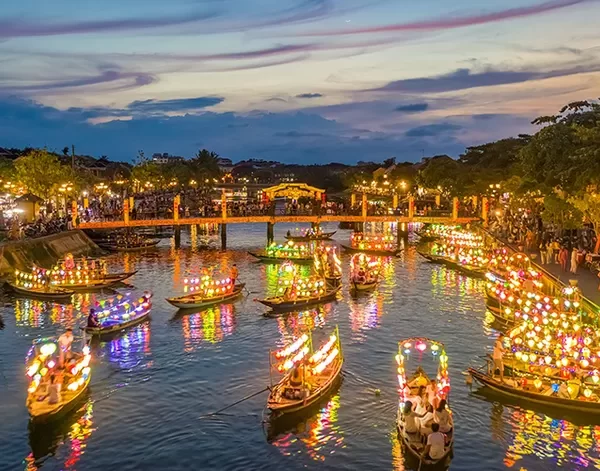
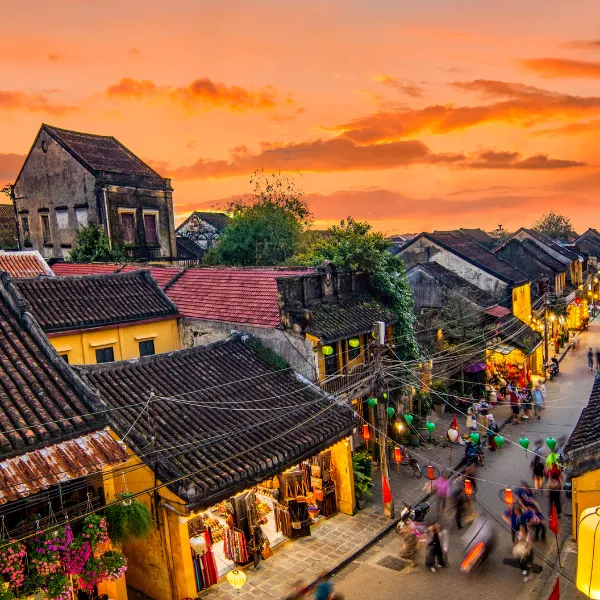
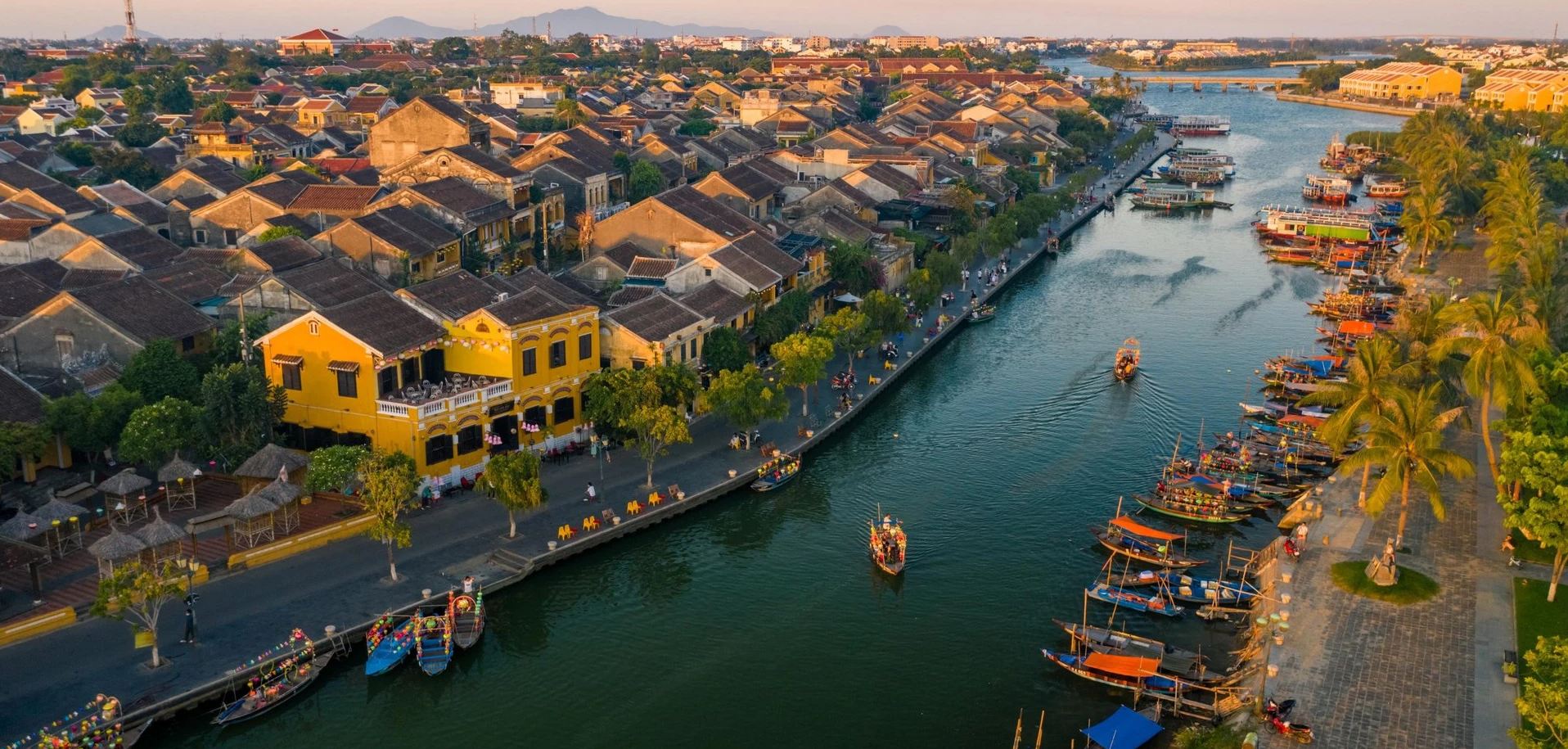
To walk into Hoi An Ancient Town is to feel the 21st century peel away, layer by layer, until only the warm amber glow of centuries remains. A UNESCO World Heritage Site preserved in near-perfect entirety, this former trading port has not so much resisted change as simply refused it — and the result is a living city that breathes, cooks, sews, and glows with the unhurried confidence of something that knows exactly what it is. The mustard-yellow merchant houses lining Trần Phú Street wear their centuries lightly: Vietnamese roof curves, Japanese joinery, Chinese lattice windows, and French shutters all layered onto a single facade, each one a quiet record of the merchants and mariners who converged here from across the known world.
When dusk settles over the Thu Bon River, Hoi An begins its nightly metamorphosis — and no photograph has ever done it justice. Hundreds of hand-stitched silk lanterns in vermillion, saffron, cobalt, and jade ignite along the water’s edge, their reflections rippling like scattered embers across the dark river surface. On the 14th night of every lunar month, the Lantern Festival silences every engine and electric light in the old quarter, returning the streets to a soft, golden hush that feels older than memory. It is in these moments — wandering lantern-lit alleys with a bowl of cao lầu in hand, its pork char-grilled and noodles drawn from a single ancient well — that Hoi An stops being a destination and becomes an emotion. One that lingers, stubbornly and sweetly, long after the journey ends.
Ba Na Hills — A Kingdom Drifting Above the Clouds
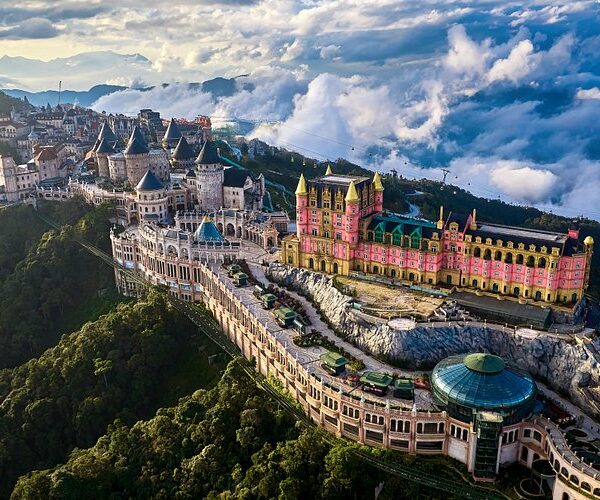
There are places in the world that exist at the boundary between the real and the imagined — and Ba Na Hills is one of them. Perched at 1,487 metres above sea level in the Truong Son Range, this mountain resort does not merely rise above the clouds; it inhabits them. The journey up is itself a prologue to wonder: board a cable car system holding multiple world records, stretching 5,801 metres over an unbroken canopy of ancient jungle, and watch the heat and noise of the coast below dissolve into cool, luminous silence. When the doors open at the summit, the air is different — lighter, cooler, carrying the faint green scent of mist and mountain — and for a moment, you will believe you have arrived somewhere that does not appear on any ordinary map.
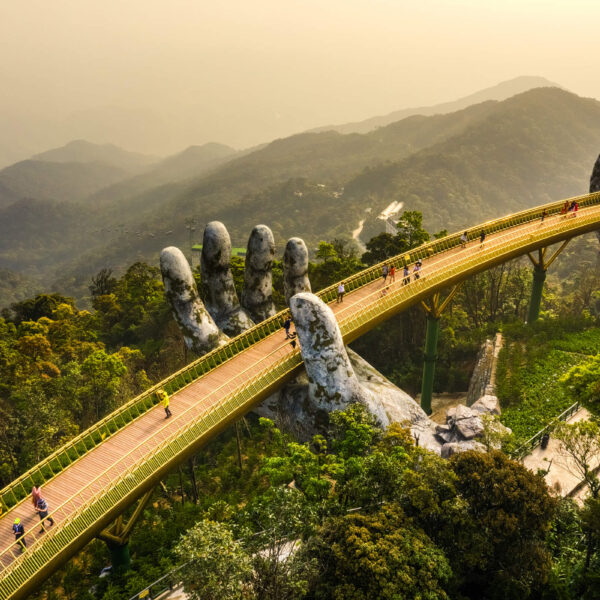
Then you see it. The Golden Bridge — 150 metres of gilded walkway cradled in the open palms of two colossal stone hands rising from the forest below, stretching out across a void of white cloud and green valley — and all language briefly fails. Opened in 2018 and instantly iconic, it has become Southeast Asia’s most-photographed landmark not because of clever marketing, but because it genuinely looks like something conjured from the pages of a fairy tale. Beyond the bridge, the French Village unfolds with medieval wine cellars, cobblestone squares, and clock towers draped in fog — a jarring and thoroughly enchanting collision of Provence and Truong Son. As evening falls and the mist thickens, Ba Na Hills retreats into soft, diffuse silence, and the whole mountain feels like a dream you are not quite ready to wake from.